

Custom Robotic Palletizing System Improves Worker Safety and Prepares Manufacturer for Future Automation
For manufacturers handling heavy or varied products, robotic palletizing systems can reduce the physical demands of end-of-line material handling while creating new opportunities for automation.
A global converting company specializing in custom paperboard packaging wanted to reduce the physical demands placed on employees who were manually lifting heavy boxes at the end of two production lines. At the same time, the company wanted an automation solution that could support its current production needs while creating a foundation for future improvements.
Pieper Automation designed and implemented a custom robotic palletizing system that automated the heavy lifting, accommodated multiple carton sizes and weights, and brought two production lines into one robotic palletizing area. The result was a safer, more flexible material handling process designed with future automation in mind.
The Challenge: Reducing Manual Heavy Lifting
Employees were responsible for manually lifting heavy boxes at the end of two production lines. The customer wanted to eliminate this physically demanding task to improve worker safety and reduce physical strain.
But the solution needed to do more than simply replace manual palletizing.
The system also needed to:
Automate palletizing for two separate production lines
Accommodate multiple carton sizes and weights
Keep pallet stacks from each production line separate
Support the company's longer-term automation goals
The customer was looking for a robotic palletizing solution that could address an immediate safety need without limiting future automation opportunities.
The Solution: A Custom Robotic Palletizing System
Pieper Automation developed a custom system capable of handling the customer's varied box sizes and heavier-than-average product loads.
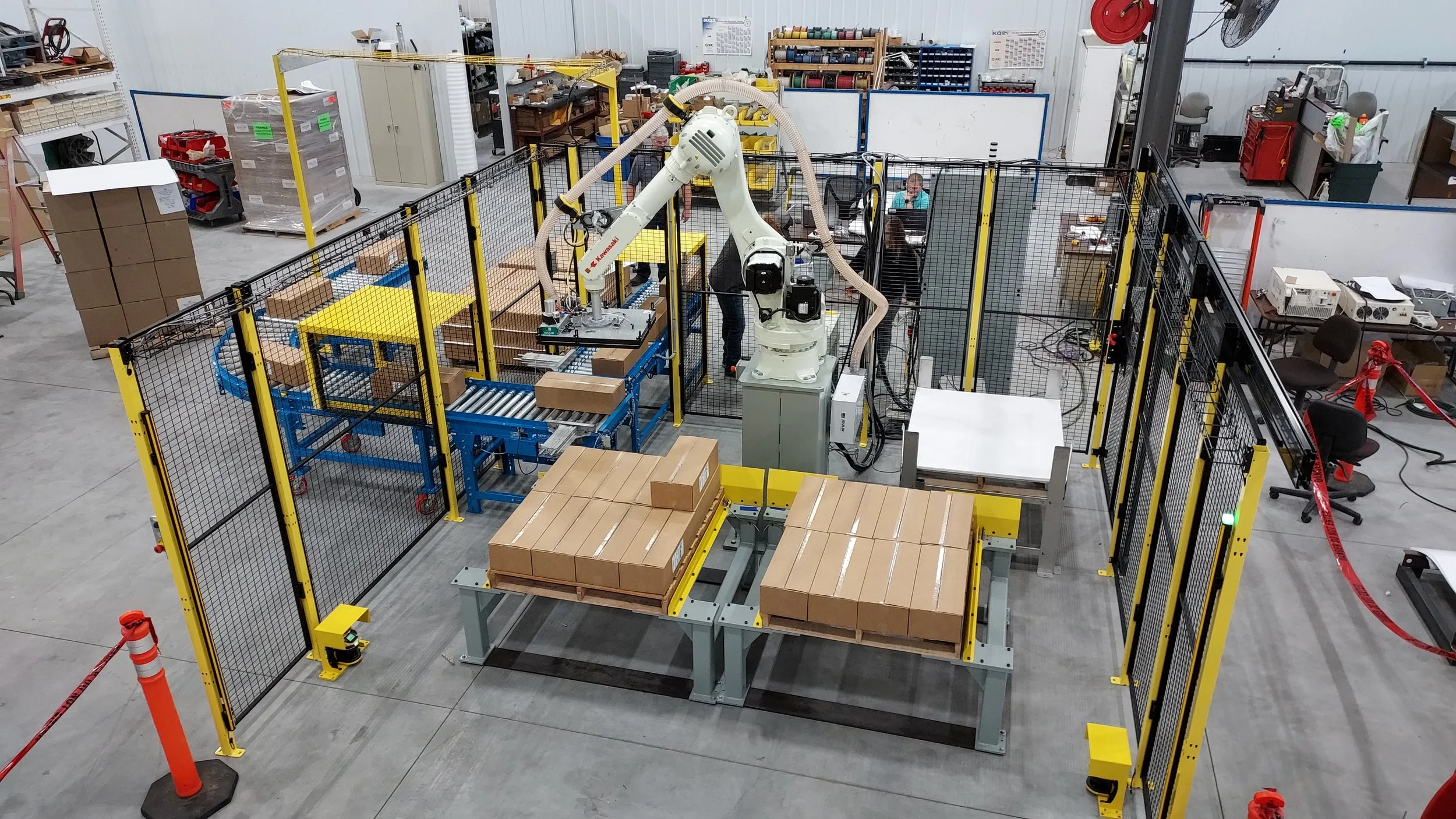
At the center of the solution is a Kawasaki robotic palletizer equipped with custom vacuum end-of-arm tooling. A custom infeed conveyor system and box-handling equipment bring products from two production lines into a single palletizing area while maintaining separate pallet stacks for each line.
The solution included:
Kawasaki robotic palletizer
Custom vacuum end-of-arm tooling
Custom infeed conveyor and box-handling equipment
Allen-Bradley Safety PLC controls
HMI interface
Integrated guarding
Light curtains
Area scanner
Installation, startup and commissioning support
By developing the tooling, material handling, and controls around the customer's specific production requirements, Pieper Automation created a custom palletizing automation system rather than applying a one-size-fits-all solution.
Combining Two Production Lines Into One Palletizing Cell
An important part of the project was combining two production lines into one robotic palletizing area while keeping the products from each line organized in separate pallet stacks.
This approach allowed the customer to automate material handling across both lines without mixing their individual product flows.
The custom vacuum tooling and conveyor-handling design also allows the system to accommodate the customer's different carton sizes and weights, providing flexibility for varied production needs.
Designing for Future Automation
The customer's goals extended beyond the immediate palletizing application.
Pieper Automation designed elevated pallet stations into the system to support potential future integration of automated guided vehicles (AGVs). In addition, barcode scanning is a potential future enhancement that would automatically provide box stacking-pattern information.
Building those considerations into the initial system gives the customer a foundation for continuing its automation journey as operational needs evolve.
The Results: Safer, More Flexible Material Handling
The most immediate result of the robotic palletizing system was the removal of repetitive heavy lifting from the production process.
Workers on each line are no longer responsible for manually lifting the heavy boxes. According to the customer, employees are safer and happier following the change. The customer also expects fewer employee injuries and continued safety improvements as automation becomes a larger part of its operation.
The project delivered:
Improved employee safety: Automating the palletizing process removed a physically demanding manual lifting task from employees' daily work.
Flexible handling: Custom tooling and conveyor equipment allow the system to accommodate varied carton sizes and heavier product loads.
Organized product flow: Two production lines feed a single robotic palletizing area while maintaining separate pallet stacks for each line.
A foundation for future automation: The pallet station layout was designed to support future AGV integration, while barcode scanning was identified as another possible future enhancement.
Custom Robotic Palletizing Solutions from Pieper Automation
Robotic palletizing isn't always a plug-and-play application. Product weight, carton size, line configuration, material flow, controls and future automation plans can all influence how a system should be designed.
For this project, Pieper Automation combined robotics, custom material handling, controls and machine safety into a solution tailored to the customer's production environment. Regular design reviews and system walkthroughs also kept the customer informed throughout the project.
Whether the goal is to reduce manual material handling, improve employee safety, automate multiple production lines or prepare a facility for future automation, Pieper Automation can develop a solution around the needs of the application.
Ready to explore robotic palletizing for your operation?
Talk with Pieper Automation about a custom robotic palletizing and material handling solution designed around your products, processes and long-term automation goals.