In today’s construction environment, speed-to-market has become one of the most important measures of project success. Owners of hyperscale projects are often focused on one question: How quickly can the facility become operational?
To meet these demands, construction teams are rethinking traditional methods and embracing innovative approaches that improve productivity, quality, and safety. One of the most impactful strategies is prefabrication.
A recent duct bank prefabrication effort demonstrates how early planning, digital coordination, shop fabrication, strategic partnerships, and field collaboration can transform the way underground electrical infrastructure is delivered.
Rethinking the Traditional Duct Bank
Traditionally, duct banks are assembled in the field. Crews build conduit arrays section by section in open trenches, installing individual spacers and supports while working around weather, labor availability, and site constraints.
The project challenged the team to find a better way.
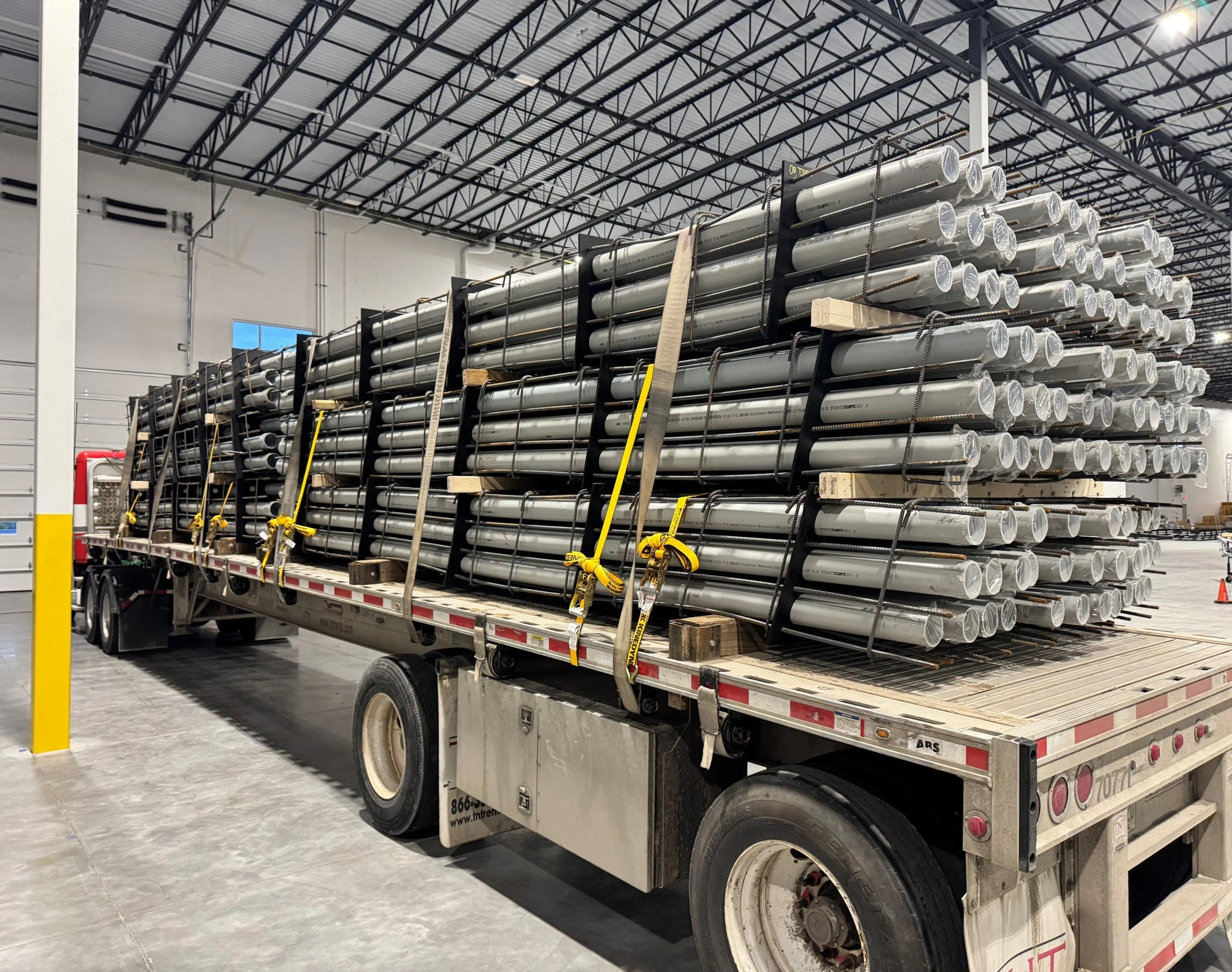
Rather than building duct banks in the trench, the team shifted much of the work to PieperPower's East Troy prefabrication facility, where complete duct bank assemblies could be built in a controlled environment and delivered ready for installation.
The approach was simple in concept but transformative in execution: complete as much work as possible before the materials ever reached the jobsite.
The Foundation: Preconstruction and Digital Planning
Successful prefabrication begins long before materials enter the shop.
The Pieper Construction Services team worked closely with field personnel during preconstruction to model the underground electrical systems, identify conflicts, and ensure constructability. Combining software expertise with real-world field experience, the team developed a highly coordinated plan that reduced uncertainty before excavation began.
Using BIM technology, the team coordinated routing with underground utilities and other trades, resolving potential conflicts with sewer, water, gas, and other site infrastructure before construction started.
This upfront planning significantly reduced rework and allowed crews to proceed with confidence once installation began.
Precision Through VDC and Layout Technology
The value of digital construction extended beyond coordination.
The Construction Services team leveraged advanced modeling and layout technologies, including Robotic Total Stations (RTS), to improve field accuracy. Every critical installation point was modeled and referenced digitally, allowing field crews to place anchors, supports, and infrastructure with exceptional precision.
Instead of relying on traditional measurement methods, crews can utilize model-driven layout information directly in the field, reducing errors and improving installation efficiency.
This level of precision supported the overall prefabrication strategy by ensuring shop-built assemblies fit exactly as intended once they arrived on site. The field team was equally confident in the installation results, noting that the prefabricated duct banks were installed significantly faster than they could have been using traditional field-built methods.
An Innovative Approach to Prefabrication
One of the most significant innovations developed during the project involved the duct bank spacer system itself.
Traditional duct banks often rely on individual plastic spacer "chairs" that must be assembled piece by piece in the field. While effective, the process is labor-intensive and time-consuming.
To streamline production, the team utilized custom high-density polyethylene (HDPE) spacers that could be CNC cut as single components. Rather than positioning dozens of individual spacers, each CNC-cut panel supports the complete conduit array in a single assembly.
At the East Troy facility, the spacers are loaded into specialized fabrication jigs. Electricians can then install conduit and reinforcing steel at an ergonomic working height, improving productivity while reducing strain on craft professionals.
The result is a repeatable, highly efficient manufacturing process that produces consistent, high-quality assemblies.
Managing Complexity at Scale
The project required far more than a single duct bank design.
Over the course of production, the team fabricated approximately 25 different duct bank configurations to support varying site conditions and electrical requirements. These included both direct-burial duct banks and reinforced assemblies designed for concrete encasement.
Despite the variety, the prefabrication process maintained consistency and quality while enabling production at a scale that would have been difficult to achieve using traditional field-built methods alone.
The project's success proved that duct bank prefabrication could be applied to large, complex infrastructure projects with significant benefits.
Solving Labor and Scheduling Challenges
The construction industry continues to face skilled labor shortages, particularly on large-scale projects that require significant manpower over compressed schedules.
Prefabrication provides a powerful solution.
By shifting labor-intensive work from the field to the shop, project teams can better leverage available resources and create efficiencies across multiple projects. Shop production also allows work to continue regardless of site conditions, weather delays, or scheduling constraints.
For project managers, this creates additional flexibility. Larger scopes can be pursued with greater confidence knowing substantial portions of the work can be built in parallel with field activities.
The ability to fabricate assemblies while site work continues creates a powerful schedule advantage, helping projects maintain momentum and meet demanding completion dates.
Overcoming Logistical Challenges Through Partnership
Innovation rarely happens without obstacles.
One of the team's biggest challenges involved transporting completed assemblies to the jobsite. The project’s strict safety and background requirements limited the number of trucking vendors eligible to access the site.
Working collaboratively, the team established a solution through a partnership with MP Systems, which was already active on the project supporting site lighting installations.
The partnership provided reliable transportation, flatbed support, and flexible trailer-drop scheduling that allowed materials to be delivered efficiently while meeting all project requirements.
This level of collaboration demonstrates how successful projects often depend on strong relationships beyond the electrical scope itself.
Continuous Improvement in the Field
Another key contributor to the project's success was the feedback loop between the shop and the field.
Installation crews provided valuable insight that helped improve future duct bank designs. Small adjustments, such as modifying rebar placement near assembly connections, made installation more efficient and simplified field joining of sections.
These lessons learned helped refine the system and establish best practices that can now be applied to future projects.
The result was not only a successful project, but a continuously improving process that becomes more efficient with each deployment.
Building a Better Model for the Future
The duct bank project served as a proving ground for what is now becoming a repeatable construction strategy.
Its success has already influenced additional projects, helping demonstrate how prefabrication, digital coordination, and field collaboration can work together to improve safety, quality, schedule performance, and labor efficiency.
For owners pursuing aggressive construction schedules, the benefits are clear:
Earlier project readiness
Reduced field labor requirements
Greater installation accuracy
Improved safety
Consistent quality
Better protection from weather-related delays
Most importantly, this approach allows construction teams to focus on delivering projects faster without sacrificing quality.
A Team Effort Worth Recognizing
Projects like this are only possible when multiple groups work together toward a common goal.
The success of the duct bank initiative was driven by collaboration across preconstruction, construction services, prefabrication, procurement, logistics, project management, field leadership, installation crews, and trade partners.
From the VDC professionals coordinating underground systems to the teams building assemblies in East Troy and the field crews installing them onsite, each group played a critical role in transforming an ambitious idea into an operational reality.
Their collective effort demonstrates what is possible when innovation, planning, and craftsmanship come together to solve complex construction challenges.
As demand for speed-to-market continues to increase across the construction industry, projects like this show that the future of electrical construction is not just about building faster. It's about building smarter.